×

eChinacities Job Search
The best China job app
Have you ever stopped to ask yourself why it is that Chinese restrooms are lacking in toilet paper? Why pregnant women wear those apron-thingies on their way to work? What the obsession with keeping noisy, screeching crickets is about? Why people walk backwards in the morning, all the while clapping their hands rhythmically? Or why that peddler wakes you up with his yelling early in the morning?
Everyday activity can astound and bewilder us when we’re not familiar with the culture. So why is it that Chinese people do what they do? Why is it that…
1) Chinese restrooms don’t have toilet paper?
The empty toilet paper dispenser of a Chinese public restroom has quite a few things in common with your least favorite sweater: it’s ugly to look at, it isn’t being used, and every glance at it reminds you of what could have been.
Anyone who has been in Mainland China for longer than one week knows that finding a public bathroom that actually stocks toilet paper is near impossible. Sure, you can go to the third floor of that fancy-looking hotel while pretending you’re a guest, but that doesn’t really count. Besides, the last time I tried, they didn’t have toilet paper either.
But why?
Most of us immediately think it’s so whoever owns the bathroom can save someRMB. I did too, until I noticed a peculiar incident at the local KFC.
One day, when I was standing in line at KFC, a little old woman in her sixties came by and stood next to the counter. She didn’t buy anything. Instead, she pressed the straw dispenser. She pressed it over twenty times. I watched as she collected a huge bundle of straws, dump them all in her purse, and walk out of KFC without buying a thing.
What the old woman did wasn’t technically stealing. She was simply taking advantage of whatever she could get for free. The same could be said for toilet-paper thieves.
The stealing of toilet paper from public restrooms is common practice throughout all of China, frustrating city management and business owners alike. Few are willing to stock their bathrooms with toilet paper when guests simply take the entire roll home with them.
Although stealing something as cheap and ordinary as toilet paper may seem ludicrous to us Westerners, bear in mind that the salary of an ordinary Chinese service worker is little more than slave wages to most of us. A roll of toilet paper may seem so insignificant to us that we won’t bother carrying it all the way home with our bare hands, even if it were socially acceptable to do so. But for many Chinese people who live on less than 2000 Yuan a month, they see a cost that could be avoided.
2) Why do pregnant women wear those apron-thingies?
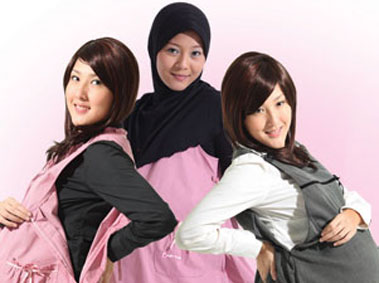
You notice that your pregnant coworker wears a childish, apron-like maternity dress whenever she sits in front of her work computer. That’s nothing unusual—maybe it’s a fashion statement. It’s certainly better than some of Kim Kardashian’s maternity clothes.
But then, you notice she wears the exact same apron-like maternity dress every day. Surely she can spare the money for two different maternity dresses, right? Why does she wear the same dress every day?
The reason? Her maternity dress is more than a maternity dress—it is an anti-radiation apron.
A what?
In China, there is widespread belief that low levels of radiation emitted from computers can cause birth defects and/or other negative effects on pregnant women. Two of my father’s Chinese graduate students took a hiatus from their studies just to avoid using a computer during their pregnancies.
But wait, you ask. How come I’ve never seen pregnant women in my own country use these anti-radiation maternity dresses? That’s because the fetus-harming computer radiation theory is a bunch of baloney, according to the World Health Organization. However, this has not stopped businesses from profiting off of such fears.
Anti-radiation clothing has also been reported to do more harm than good. This is because clothing that blocks out radiation can also trap it in. This would, in turn, expose a pregnant woman to more radiation than what she would have normally received, had she not worn such clothing in the first place.
Unfortunately, China does not have any industry standard that prevents such clothing from being sold.
3) Why do Chinese people like crickets so much?
It’s hard for a Westerner to understand why Chinese people love to keep crickets as pets. They make a loud ruckus from dawn to dusk that resembles the ringing you get in your ears when you smack your head against the open cabinet door.
What’s more, these hard-shelled creatures aren’t the least bit cuddly. You don’t want to touch them, they live for two months tops, and your daily interaction with them is the five seconds it takes to push that little bean through the holes of its bamboo cage every morning. Why do Chinese people, especially old Chinese people, love to keep these six-legged pests around so much?
The reality: Crickets have been in Chinese culture for thousands of years, beloved by emperors and commoners alike. Chinese cricket culture involves two different types of crickets: singing crickets, and fighting crickets.
Singing crickets, or jiaoguoguo, are pets for children. According to legend, singing crickets were kept by imperial concubines to feel less lonely. (Like many Western families, a Chinese family that desires pets can sometimes find a dog or cat too furry, too messy, or too darn bothersome to take responsibility for.) But while a Western family may settle for something quiet and fuzzy like a hamster or a gerbil, the Chinese settle for crickets.
In some ways, the cricket can be an ideal pet: it costs very little, doesn’t stink, is easy to take care of, and is roughly 35% more interactive than a goldfish. Its short, two-month lifespan also means that a Chinese child can play with it all summer before forsaking it once the school year starts up.
Fighting crickets, or xishuai, are used for entertainment purposes. While Western countries have familiarized themselves with cockfights and bull fights, the Chinese send crickets at their opponents. Money is often involved, despite China’s outlaw on gambling.
4) Why do old people walk backwards in the morning?
When I lived in the dorms at East China Normal University, I could always peek out my window and see old people walking backwards along the track field early in the morning or late at night. They clapped their hands together methodically while doing so.
Walking backwards, or “retrowalking,” is a form of light exercise that the Chinese have been doing since ancient times. Walking backwards is more tiring than walking forwards, and this will give you a better cardio workout in general. But that’s not the only effect it has: according to an article published in the North American Journal of Medical Sciences, retrowalking has a positive effect on patients with knee osteoarthritis. And you know who has osteoarthritis? Old people.
That isn’t where the benefits of walking backwards ends. According to a Dutch study, walking backwards may also sharpen your thinking.
And as for the hand-clapping? While the methodical hand-clapping may look silly and resembles a poor man’s chest fly, it does give your arms some exercise to do.
5) What is that old peddler guy calling out every morning?
After you have lived in China for long enough, you will notice that every once in a while, an old Chinese man with a bench and a bike will ride through your neighborhood slowly while calling out the same phrase, over and over again. And no, it is not the same old man pedaling through all of China on a Forrest Gump-inspired journey.
What this man is actually saying is “mo jian zi lai…qiang cai dao!” which means “I’m here to sharpen your knives…and your scissors!”
This man is a blade sharpener. He goes from street to street, sharpening kitchen knives for a couple of RMB. This profession is dying, since most Chinese people now have their own whetstones in their kitchens. Thus, today’s blade sharpeners are well over the age of fifty and have decades of blade-sharpening expertise to boot. The few blade sharpeners that remain still get business, thanks to customers who desire exceptionally sharp blades.
Warning:The use of any news and articles published on eChinacities.com without written permission from eChinacities.com constitutes copyright infringement, and legal action can be taken.
Keywords: Chinese activities
All comments are subject to moderation by eChinacities.com staff. Because we wish to encourage healthy and productive dialogue we ask that all comments remain polite, free of profanity or name calling, and relevant to the original post and subsequent discussion. Comments will not be deleted because of the viewpoints they express, only if the mode of expression itself is inappropriate.
Please login to add a comment. Click here to login immediately.

Nice article. 1. Toilet paper. For a few months I ran a bar/restaurant in Xishuangbanna. Backpackers were impressed with toilet paper, and locals never stole any. But you're right - I guess we never got any really poor people in. 2. In my more normal guise as a teacher in private schools, I would like to add a comment to the pregnncy observation. Women who get pregnant, start wearing 'pregnant clothes' as soon as it's confirmed. Radiation apart - they want to show off the fact of thei (usually only) pregnancy. Any thoughts on staying in bed for a month and not washing your hair etc? 3. A student told me that walking backwards stimulates the 'other' half of your brain? John.
Jul 05, 2013 16:03 Report Abuse
Further info about the anti-radiation maternity clothes can be found at: http://www.szdaily.com/content/2011-12/21/content_6325648.htm
Jul 02, 2013 10:46 Report Abuse

Apart from the toilet paper I didn't know any of those other things. Interesting and just adds to the weirdness of this place. Or are we strange and they are normal? Another 2 years here carrying my own toilet paper everywhere I go and I will think it's normal!!
Jul 01, 2013 23:07 Report Abuse

Just give into the way things are run here. A 6 pack of Tempo napkins runs for 6 kuai at the local luxury grocery store. It is soft and doesn't rip, even when wet. Just carry a few packs of those around and you'll be fine. Too bad they don't just do it SE Asian style and have a hose in the stall, it's much cleaner that way.
Jul 02, 2013 19:07 Report Abuse
You must be a male for one because a female would just think of it as another thing to carry in her purse and move on about it. Since you have seen all of China already and know everything then I hope you never go out from your house again. Or if you do, don't forget your nappie as it would be absolutely ridiculous to have toilet paper on your person should the need ever arise. You are living a sheltered and useless life. Congratulations, your parents must be so proud.
Jul 07, 2013 14:31 Report Abuse
(1) How is ESL teaching not "the real expat world"? (2) There is plenty of reason a western person would live like that. It is China, after all. If you expect businesses to provide your toilet paper for you, then you must be very limited in where you go here. (3) What is a "normal" "successful" life? Sounds like something where you have all the "security" but no zest in life. The sort of expats who think ESL teachers are below them, or are not living a "normal successful life", need to get over themselves.
Jul 07, 2013 21:19 Report Abuse
OK, that makes more sense, but at the same time, I don't know that the kind of "progress" you speak of is that attractive for the adventurous types who would come here as ESL teachers. If someone wants the sort of western lifestyle that you are speaking of, they should go back to the west, where it's going to be a lot cheaper (due to fewer import taxes and more selection), more secure, and will come with a money-back guarantee. The question is: are there options for staying here long term other than ESL teaching (or teaching, say, in an international school) or working for an MNC? Also I have met a number of people who are quite "poor", make less than 10 dollars a day, but seemed to have quite decent lives.
Jul 08, 2013 15:07 Report Abuse
OK thanks for the time put forth in explaining that. I teach a subject level class for an international program (Chinese management) and find it satisfying and well-paying, but it doesn't come with basic-level security such as a pension and good insurance. So something better would be interesting. At the same time, getting stuck in a cubicle job or similar unsatisfying job, does not sound like a good trade-off. There must be something in the middle, a career that's interesting and "cool" but also provides some level of security.
Jul 09, 2013 11:25 Report Abuse
"as telling people here you're a teacher" Well you're certainly welcome to live as you want to live, but it seems like an unwise mistake to base one's career entirely on how it makes you appear to others. To give an example, I have a family member who is (by your standards) very successful, a high-level corporate lawyer in the US who pulls in a big salary, wines and dines with judges and politicians, all that jazz. The only problem is I can see that none of this makes this person happy, at the end of the day. The buzz wears off. Also the fact that local girls in Shanghai would look down on somebody simply for being an ESL teacher makes them seem completely superficial. Teaching is an honorable profession. If sb looks down on a person simply for being an ESL teacher...well they're probably just a gold-chaser to begin with. The more I hear about Beijing and Shanghai lifestyles and attitudes, the more I think "you can keep your snotty attitudes, and keep your nasty air as well!".
Jul 13, 2013 19:58 Report Abuse
Well even if it's closer to working at Starbucks than being a high school lit teacher, there are certainly ways to use it to further your career. In some ways it might be better than an overglorified "analyst" who's paid $70,000 pa to make excel spreadsheets and PP presentations. Also one of the great things about Asia is they don't have the politically correct nonsense that acts like totalitarianism in the west, in fact there's reverse sexism and a "ambitious and talented" woman can generally get her way over men, it's completely backwards and I hope the PC movement does not come to Asia, it should stay in the west where it has already done enough damage to the family.
Jul 15, 2013 15:46 Report Abuse



 Sign up with
Google

 (
 (