There has been a recent spate of articles lambasting the commercialization of Beijing’s 798 art district – supposedly now the third most visited tourist attraction in Beijing. Not too shabby considering the first two are the Great Wall and the Forbidden City, and a decade ago, 798 was merely a dusty group of empty munitions factories being rented by a handful of artists seeking cheap studios. The charge of articles like the Beijing Review’s “Has 798 Sold its Soul” is that the area has become too commercial – visitors to the area are more likely to be Chinese high school students snapping photos with the art, rather than curators armed with advanced degrees or, even better, collectors armed with checkbooks. “Serious” gallery owners have fled to nearby Caochangdi for cheaper rent, larger spaces and to escape pesky gallery goers. But now, rumors are circulating that 798’s cultured older brother Caochangdi – the area 15 minutes from 798 that has been usurping it as the place to see quality Chinese contemporary art – will be torn down and replaced with commercial developments (the really bad kind of commercialization). It turns out that the very things cited as 798’s downfall – tourists, government support, shops – have saved 798, and in some respects, Beijing’s contemporary art scene.
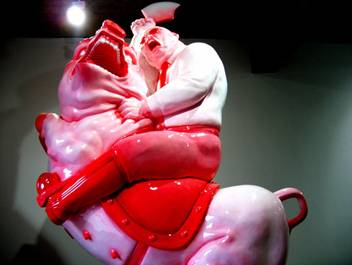
Photo: adifromusa
I don’t think it’s a good thing, I don’t think it’s a bad thing,” says Vivi, an artist who works in a 798 gallery whose recently constructed Caochangdi space is now facing the wrecking ball, “I think it’s natural. Art will find a place.” There’s no doubt that 798 has become a circus. Souvenir shops crowd out galleries, and many galleries exhibit nearly identical work – minor variations on worked over contemporary Chinese art tropes: girls with big eyes and skimpy clothing posed juxtaposed with emblems of traditional Chinese culture. “There are still some good galleries existing here,” says Vivi, “not the pioneers, but there are still good ones.” Vivi is not alone in worrying that the glut of shops hawking identical goods will be detrimental, “The tourists can compare; if 798 goes the same way as a flea market they will not come, they will just got to Panjiayuan.”
Declaring that an market has become too commercial is always problematic: markets are about commerce, the art market is no different – it’s a luxury commodity that’s bought and sold, often for investment reasons (who likes a painting so much they’re willing to fork out $9.5 million for it – the price one collector paid for an oil painting by Zeng Fanzhi). The Renaissance masters we revere today were working for the Medicis or popes. They weren’t barbecuing with friends or attending openings, they were churning out flattering portraits of their employers. Leonardo DaVinci wasn’t hired for his portfolio of ladies with enigmatic smiles, he was hired because he had invented a wide variety of terrifying torture implements and military devices.
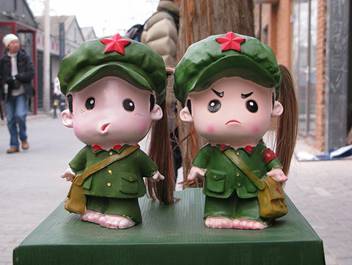
Photo: bfishadow
The people bemoaning the commercialization of 798 complain that the crowds flocking 798 now aren’t serious about art. The “serious” viewers are willing to head out to Caochangdi, Jiuchang and Feijiacun to view the “medium-priced” work where collectors are still willing to shell out 30-500,000 USD. Are the artists and gallerists looking to sell work for six and seven figure prices threatened by the gift shops selling five kuai postcards and fifty kuai mugs with witty Chinese slogans on them?
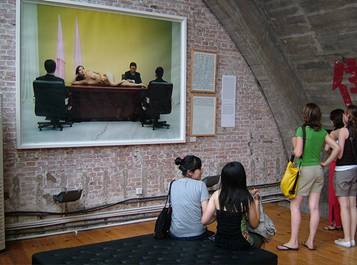
Photo: sprklg
798 has become a destination for both foreigners and the thousands of Chinese that throng to the area every weekend. Admission to the galleries is free (with the notable exception of the UCCA), it’s easily reached by public transport, and the dozens of galleries (estimates put the number of galleries between 60 and 100, and more are opening all the time) provide more than enough amusement for an entire day.
“In many ways, 798 has become more easy and enjoyable for the casually interested,” says Andersen, “There are a lot more cafes and restaurants, English on the menus, art galleries and little shops to buy crafts, clothes, etc. The taxis also all know where to take you to when you only know how to explain the place as "798" now too (which makes a big difference!)”
Ultimately, if the serious galleries want serious viewers and clients, customers who are buying the work because they love it need to be educated and passionate about art. “It is also great that there are so many young people coming everyday to see what is happening in 798,” says Andersen, “At least they are seeing an alternative vision of China, with different possibilities, and not just what the government or big business wants them to see.”
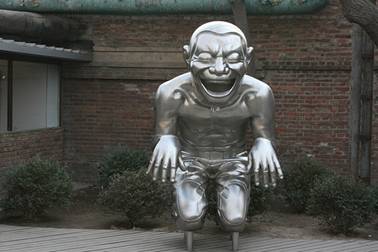
Photo: storyvillegirl
Since the “serious” art people seem to think that hanging out in a place with art isn’t worth much, they might want to mull over this: the teens wandering 798 in their school sweatsuits, holding hands and taking cell phone pics next to paintings, will grow up to be China’s middle and upper-middle class – the very people galleries are counting on to start buying Chinese art, as the foreign buyers (an estimated 70-80% of the buyers of contemporary Chinese art) move on to India or Thailand, or stop buying as the west is crunched by the economic crisis. “The commercialization of 798 is the complaint of the artists and the galleries,” says Vivi, “But for me, it is more important to educate, teach, give the people something different.”
Unfortunately, it seems now that the commercialization of its original art district is not the only worry facing Beijing art lovers. Many of China’s best galleries have recently set up in Caochangdi, and their glowing white million dollar galleries may soon be reduced to stacks of bricks carted out of the area by migrant workers with donkey carts.
“The moving of Caochangdi is what we should protest,” urges Vivi, “That’s what’s terrible. If we want to make protest we should do something about that. “
***
Related Links
2009 Beijing 798 Art Festival
After the Fall: What Contemporary Chinese Art Must Do to Survive the Crash
Beijing's Modern Collision of Factories and Contemporary Art: 798!
Warning:The use of any news and articles published on eChinacities.com without written permission from eChinacities.com constitutes copyright infringement, and legal action can be taken.
All comments are subject to moderation by eChinacities.com staff. Because we wish to encourage healthy and productive dialogue we ask that all comments remain polite, free of profanity or name calling, and relevant to the original post and subsequent discussion. Comments will not be deleted because of the viewpoints they express, only if the mode of expression itself is inappropriate.
Please login to add a comment. Click here to login immediately.




 Sign up with
Google
Sign up with
Google