The October National Holiday is approaching and many of us are considering our travel options. China’s full of notable tourist attractions – the Great Wall, the Terracotta Warriors, etc. – but where to go once you’ve visited all the obvious places? The following five spots are perfect for people looking to investigate China further, away from the chattering tour guides, maddening crowds and jacked up prices which mar many of China’s historic sites. Get off the beaten track, put away the tourist map and read on.
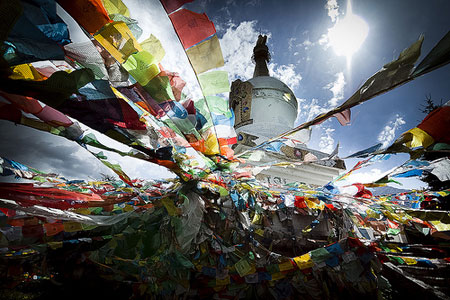
Photo: Mathieu Gasnier
1) Western Yunnan: Tengchong and Ruili
While Dali, Lijiang and Shangri-La are on most people’s lists when they visit Yunnan, few venture as far as Tengchong and Ruili, two cities on the border of Burma which offer the perfect mix of natural beauty, fascinating local culture, and historical interest. Tengchong is home to a dormant volcano, amazing hot springs, a charming old town with old style Chinese architecture as well as a community of Burmese exiles. For history buffs, Tengchong is also the site of one of Yunnan’s major battles of WWII, which is commemorated in a memorial park at the site of the fiercest fighting. Ruili is a tropical city much like Xishuangbanna, with nearby rainforests and waterfalls, but what is most fascinating about Ruili is the border community at the edge of town and the Burmese influence which is apparent there. Aside from the Burmese culture, Dai culture also flourishes in Ruili. For those who have been there and done that in Yunnan, Tengchong and Ruili can provide a refreshing alternative to the Dali-Lijiang tourist trail.
2) Xinjiang Province: The Silk Road
Despite the problems in Xinjiang over the years, Xinjiang remains one of China’s most fascinating mixtures of cultures. The Uighur culture in particular is almost completely distinct from Chinese culture, with their own language, culture, and customs, and Uighurs often look more foreign than Chinese in appearance. Xinjiang is also home to breathtaking desert scenery, majestic snowcapped mountains, ancient mosques and bazaars in towns like Kashgar. Xinjiang is also known for great food, which more resembles Middle Eastern food than Chinese food and is heavy on breads and curry or biryani-like dishes, as well as the famous Xinjiang ban mian, sometimes called “Chinese spaghetti.”
Also alive in Xinjiang is a strong musical tradition, with many distinct local instruments and a style of singing which will remind you a bit of Indian or Arabic styles. If you have a taste for the exotic but don’t want to leave China, Xinjiang could be the perfect way to explore the cultures of Central Asia without even needing a new visa.
3) Qinghai: Tibet without the permits
Outside of Tibet itself, Qinghai, along with Sichuan and Yunnan, is one of the homes of Tibetan culture. Qinghai boasts a diverse landscape, with snow-capped mountains, grasslands and deserts, as well as China’s largest inland salt water lake. Qinghai is also home to one of the six great monasteries of the Yellow Hat sect of Buddhism, Ta’er Monastery, which is more than 400 years old. Qinghai is home to a lot of wildlife and even boasts a nature preserve. If you want a taste of Tibetan culture but can’t afford the permits for Tibet, or if you just want to see some breathtaking scenery in an off-the-beaten path location, try out Qinghai.
4) Xiamen: The gate of China
Located just across the straight from Taiwan, Xiamen is a coastal city in Fujian Province and is widely considered to be one of the most attractive cities in all of China. Xiamen has beautiful natural scenery, fresh clean air, and a subtropical climate with mild weather all year round. There are many small islands surrounding Xiamen and travelers can tour these by boat. There are also clean sandy beaches which, while not necessarily the best places to take a swim, are great for a stroll. In the West, for a long time Xiamen was more widely known as Amoy, the name of the city in the local language, Hokkien, a language spoken mostly in Fujian and Taiwan.
5) Western Sichuan: Kham and the Khampas
Western Sichuan is a remote region and travel there is not for the faint of heart, but if you have the fortitude to trek through remote regions and travel in less than five star style, Western Sichuan will not disappoint. Originally this region was known as “Kham”; a set of small Tibetan states which included this area as well as parts of Qinghai and Yunnan, and the inhabitants of Western Sichuan were called the “Khampas.” There are so many areas of interest to choose from in Western Yunnan, from horseback riding from Songpan into Jiuzhaigou, to Kangding and the Hailuogou glacier. One could easily spend a couple of weeks trekking around Western Sichuan and still not see it all. Many also attempt to cross overland from Western Sichuan into Tibet proper, and while this is currently not possible, the relentlessly adventuresome traveler may be unable to resist the urge to try.
Warning:The use of any news and articles published on eChinacities.com without written permission from eChinacities.com constitutes copyright infringement, and legal action can be taken.
Keywords: Western Yunnan Western Sichuan Off the Beaten Track Destinations in China
All comments are subject to moderation by eChinacities.com staff. Because we wish to encourage healthy and productive dialogue we ask that all comments remain polite, free of profanity or name calling, and relevant to the original post and subsequent discussion. Comments will not be deleted because of the viewpoints they express, only if the mode of expression itself is inappropriate.
Please login to add a comment. Click here to login immediately.

Ruili? Off the beaten track? It's going to be rammed this week according to the good people on the Gokunming forums.
Oct 02, 2015 10:58 Report Abuse
The Uyghir culture is completely distinct from the Chinese culture, as stated in the article. Whilst the Uyghirs are the biggest minority (majority) in Xinjiang, there are many others as well. Where I live, Kazakhs are more predominant. And music plays a big part for all of them (although there is less of it evident in the day to day life than was the case several years ago). All minority people are friendly and welcoming and being in their company is always a pleasure. The food can be wonderful and usually quite different to Chinese food (thank goodness!). I concur, too, with the article about the landscapes here. They are often totally breathtaking! It might sound as if I like it here. Well, in point of actual fact (Featherism), I do!
Sep 30, 2015 16:56 Report Abuse



 Sign up with
Google
Sign up with
Google
 (
( (
(